Sunday, September 7, 2014

Joining the Roosevelt Ghosts of 129-131 Fifth

The buyer has signed the contract for our apartment, and our family will soon become one more set of ghosts to inhabit the spaces of 129-131 Fifth Avenue.  Within two weeks of it being on the market, our place had over 50 visits and 11 offers.  We accepted that of a young single woman, a lawyer, who "loved it immediately" and is already planning to redo the kitchen (a wise first decision).  She will soon own a wonderful apartment in a wonderful building, a modest gem of Manhattan history.  
The address of the original site that later launched our building was 4 East 20th Street, and the first known ghost in that space belonged to Teddy Roosevelt's uncle, Silas Weir Roosevelt, who, with three of his brothers -- Teddy's father, Robert, and James -- owned homes on the south side of 20th Street between Fifth and Park.  They were all sons of Cornelius Roosevelt, one of the founders of Chemical Bank (now Chase) and the fifth richest man in New York City. (Teddy himself was born a block and a half from our building, and his birthplace was reconstructed and memorialized in the mid-20th century as an appealing little museum.)  
Silas, the owner of our space, was a Commissioner of the Public Schools and a lawyer.  He had a wife and children and seemed to be well liked by his peers.  He was also an amateur poet, whose verses, although conventionally Victorian, showed a warm and sensitive nature.  Sadly, Silas only lived to be 47, dying in 1870, I assume in some dark room on our mutual site, after what was described as a protracted, painful, and "tedious" illness.
Since the late 1860s, the neighborhood around the Roosevelts' homes had been transforming into Ladies Mile, the hot Manhattan shopping center of its time. In 1870, the year Silas died, Lord & Taylor claimed the corner of Broadway and 20th with a five story cast iron building and one of the earliest steam elevators.  Two years later, Teddy's father, unhappy with the commercialization of the area, particularly at his doorstep, and perhaps affected by his brother's death, moved uptown.  The other brothers deserted 20th Street soon afterward. However, although the family didn't want to live there any more, they were not opposed to taking financial advantage of the new environment.
In the late 1870s, the Roosevelt estate converted James Roosevelt's former home at 6 East 20th and Silas' at 4 East 20th street for commercial use.  The latter building (and, as a reminder, our future site) became the location for the New York Exchange for Women's Work.  This organization, founded to provide Civil War widows a living by selling on consignment "almost everything that is useful or beautiful that can be devised by the quick ingenuity of a woman's brain, from the darning of a stocking to the adornment of a plaque" lasted an unlikely 125 years.  (The Exchange only stayed on 20th Street for a few years, however; it moved to Madison Avenue, where it continued to sell consigned hand-made items until high rents and a dearth of knitters forced its closure in 2003.)
In 1890, the Roosevelt estate replaced James' old house with a leased extension to Lord and Taylor's store.  Then 10 years later, in 1900, they unsentimentally knocked Silas' house down and replaced it with the Beaux Art structure that I know and love today.  This became a further addition to the ever-expanding Lord and Taylor and was linked to a building at 129 Fifth, allowing the store to stretch down 20th Street and gain a Fifth Avenue entrance and address.
Shortly after the turn of the 20th century, Lord and Taylor moved uptown, along with most of the other large department stores that had flourished between Fifth and Sixth. The splendid spaces of those "commercial palaces", as they had been described, were subsequently humbled with small industries and dusty wholesale showrooms, although with the basic bones of the structures preserved and ready for their 21st century resurrections.
Our small Beaux Art wing of the Lord and Taylor palace, which faces 20th Street, spent most of the twentieth century as a humdrum place for glass dealers and importers. At some point, it was severed from its long departed Lord and Taylor master by a parking lot.  This half of 129-131 Fifth has been described as "framed by piers, with the [neo -Greco] façade divided into three bays by slender columns resting on high bases and topped by imposts decorated with stylized paterae [which I Googled and found were ancient Roman shallow libation bowls].  These support lintels are decorated with incised ornament and simple projecting cornices.  At the second and third story levels spandrel panels are set beneath the windows; those on the second story are ornamented by recessed panels but have lost their sill moldings, those on the third story are decorated by raised panels." 
In 1979, 129-131 Fifth was converted to a coop, and in 1989, we purchased our apartment on that third floor. At the time, Michael and I were merging two families, and the previous owner had cleverly duplexed and designed the place so that we could squeeze our five kids, if needed, into its 1300 square feet. When we moved in, Willie, my younger son, was six and our other four kids, Geoff and Jill (mine) and Sarah and Jeremy (Michael's) were either 19 or 20.  Geoff, Jill, and Sarah generally used the apartment as a way station, but Jeremy and Will lived there for the duration.   Our daughters moved west, but for years, every Friday, Geoff, his wife Kim, and their three sons came in from Queens for family chaos night. The walls of those rooms were warmed by the art of my family and friends. I cooked for and we celebrated in the large downstairs living area our wedding, our tenth anniversary, dozens of holidays, and countless insignificant events that served as excuses to feed people we were fond of. Michael and I built businesses there, crouching in corners over our computers. These are the ghosts -- people, things, and events -- that are now drifting randomly within the newly painted walls and spruced up floors.  Leaving this apartment and walking out the door of that building for the last time will be very hard. 
Leaving the neighborhood, however, will not be.  History does not repeat itself but sometimes it seems that events may resonate over time in certain spaces, re-emerging in similar forms later on.  A version of Ladies Mile has now erupted like some plant that lay dormant for 100 years, emerging as a giant invasive weed, sending out its sprawling tendrils to produce high-priced toxic franchises across Broadway and Fifth Avenue, smothering out the native stores and attracting homogenous squeaking consumers, chewing and bagging up goods and spewing back cash. (Too overwrought?)
 Like Teddy Roosevelt's pragmatic family, we are both escaping this new commercialized version of our neighborhood and unsentimentally taking advantage of its opportunities, selling our apartment at a price way above the one we bought at.  So we'll build a new home in Hudson, where noisy birds replace noisy girls and scary dark woods replace scary dark streets.  

And maybe Silas' ghost even influenced our decision to move here, whispering his modest Victorian verses to us while we slept in the spaces where he spent is last sad years and where we spent are latest happy ones:

"For the Hudson runs like molten gold
His purple hills between;
And the hazy distance lies unrolled,
A fringe of sliver sheen,
Till earth and the horizon blend
In the faint hue of even,
As if the curse were at an end,
And the world mixed with heaven."


And of course, James Roosevelt's ghost may also be whispering from the house next door: "It's time to sell."

Monday, August 11, 2014

"Hello, I'm a Volunteer for Sean Eldridge. Do You Know Who He Is?"

One of the items on my retirement bucket list is working for the local Democrats, since, unlike in Manhattan, ones liberal vote counts in upstate New York.  So, with some futile hope that volunteering didn't involve calling people, my friend Ann and I went over to the newly opened office in Hudson, which had been set up for supporting Sean Eldridge, who's running for Congress, and other local Democratic candidates in the coming election. We were greeted by an enthusiastic young man in a large empty room, populated by hundreds of Sean posters and several long lonely tables, which reminded me of the Salvation Army Center before the lunch crowd comes in.

I was hoping for data entry and not the dreaded phone bank.  Sadly, there wasn't enough data yet to be entered.  First we needed to call people and register their responses so that we could accumulate the data that, with luck I could eventually enter.  He handed us four sheets of paper each with the names, ages, and numbers of 80 of my neighbors, whom I was about to drag from their dinners, chores, and TV shows to be annoyed, enraged, and potentially homicidal when they heard who I was.  With a sinking heart, I took the list.

I'm not a good spontaneous talker.  I become garbled.  My brain shuts down and loses any specific knowledge of nearly anything.  "Umm" becomes my preferred word choice.  Many, many years ago I ran as a delegate for the ill-fated McGovern Presidency in Bayonne, New Jersey, at the time an extremely conservative working class (can't we bring that term back?) neighborhood.  I'm ok with an audience but I suck in any one-on-one debate.   One of my tasks as a candidate was going door to door. It remains one of the most excruciating experiences of my life.  After facing and knocking on the seventh horrible door, a stern skinny woman answered.  I gave her my awkward, stammering, ignorant spiel and she retaliated with nasty fact after fact about his inadequacies and why the Democrats were killing the country.  I think I managed to throw in a couple of "buts" without any follow-up sentences, slumped off in complete humiliation, and staggered home, where I went to bed and pulled the covers over my head.

The Hudson campaign, nearly a half century later, is my next political adventure and I'm still no more competent in conducting these nightmare dialogues. Fortunately, this time I didn't have to confront Republicans or ask for money. The list comprised only registered Democrats and our main goal was to see if they even recognized Eldridge.  Most didn't.

At first I tried to talk through his bullet list of positions, but soon realized that I was droning the same liberal song we've been playing for years.  The issues cooked up by both the Democrats and Republicans have become verbal junk food.  No matter what party we're addicted to, we gobble down those tasteless words and return to the same fast-food Party day after day.  Women's choice, women's pay, minimum wage, universal health care, climate change, supportive government versus family values, jobs without government restrictions, low taxes, fundamental liberties without government interference, strong defense. Blahblahblah.  And no one wants to hear them anymore.  Even my fellow party members were unstirred by Sean's bullet list.

After three calling sessions, I realized the uselessness of offering anything about his ideas. Instead I now say the following:  "Sean is young.  He's a businessman who runs a venture capital firm that supports small businesses (I give examples).  He's rich and doesn't take any corporate money.  He has absolutely no Washington experience, and, gosh, don't we need a change?  And, by the way, he supports all the regular Democratic stuff. " Usually, I detect a burgeoning enthusiasm in my listeners. "Oh. He sounds pretty good."  I suspect that if I were calling Republicans with the same description for a candidate with similar credentials, only replacing "Democratic" with "Republican", I'd get similar upbeat responses.

So, we not only need a clean slate of candidates, we also need some shiny new issues.  Something to kick-start people's brains.  I've got some ideas. 

  • The first is universal childcare from infancy through middle school.  Establishing well-run and well-funded centers will reduce the number of welfare and food stamp recipients, and so help offset the costs for these centers.  It will reduce abortion rates, since women can then actually choose to have kids. With women able to work with more security and consistency, the disparities between men and women's pay will improve. So will children's health and education. (So don't get me started on the 40-year failure of the feminist movement to support this issue, along with the kids and working class women whom it would help, in favor of an elitist and now-entrenched gender distortion that has shored up our consumerist, careerist, shallow, vapid, greedy culture.  Just don't get me started.)   
  • My second position will solve all the problems in the Middle East. We should establish Kurdistan.  Buffering Syria, Iran, Iraq, and Turkey with a big fat oil-rich region filled with feisty Kurds who don't chew on any particular crazy religious bones and who may actually like us could be helpful. (I haven't thought this through completely, however, and of course there's the nasty process of getting there.)
  • My third issue will help equalize pay and reduce income disparity by reducing what men make to the level of what women make, which is generally more equitable (at least on the management level). 
  • My fourth position will help address both educational and environmental problems.  We use local, state, and federal income taxes to pay for education and we get rid of regressive property taxes, except for one:  we tax the amount of lawn people own in order to encourage the growth of native meadows and gardens.  Two birds.
  • Fifth and last, pay primary care docs far more money and dermatologists far, far less.  Healthcare problems solved.

I need some other issues and a name for my new party.  Meanwhile, it's back to the phone bank, and how Sean's inexperience in politics will save us all. 

Saturday, July 26, 2014

Under the Hudson Sun

Frances Mayes, in her book, Under the Tuscan Sun, included a recipe for bean soup that used Tuscan kale, with a description of those dusk-green leaves that lured me into choosing it among the first vegetables planted in my Hudson garden. I made the bean soup, which was glorious, and, when sautéed, the kale's dark chewy taste lightened up with olive oil and garlic. Soon kale replaced the ironclad spinach, which was never really welcome in my home anyway.  Also, joy, I discovered that I can keep harvesting kale throughout the summer and into the fall by amputating it's bottom leaves, similar to those African cattle ranchers who lop off pieces of cow thigh for dinner without killing the animal.  (I had only heard this story anecdotally and when I tried to verify it using Google, I couldn't find anything.  Oh well.)  I have grown kale now for years, and when crazed chefs started kneading it as preparation for salads, laughably sweetened with dates and cranberries, I too succumbed to the kale massage, squeezing and mushing those muscle bound leaves with olive oil, garlic, and lemon (no added fruity treats, however).  And although I tricked myself into believing I could actually soften up those beautiful raw paint chips, when I started serving salads to friends the confessions began to roll out. "I hate kale." "Please don't serve kale."  "Kale is horrible!"

Well, my friends, do I have the crucifer for you!  Broccoli spigariello liscia, the next contender in the latest dreary battle to make the tough so-good-for-you greens edible.  I planted this broccoli last year and waited and waited, until, after weeks, tiny little florets sprung out from the ends of the plant. They were very tender and sweet, much tastier than their lunky solo broccoli cousin. I subsequently learned that you can munch on the spigariello leaves during the summer while waiting for the tasty bits to appear.  I cut my first leaf crop last night and sautéed it with garlic.  Disappointing.  Flat and bland, although I learned today that I should have cooked the stems with them and that they taste better than the leaves. My favorite local chef also said to immerse spigariello in ice water first. I'll try again. But it might be worth it just to wait for the florets.

In any case, I am a sucker for Italian seeds and their names.  Currently in my garden, in addition to the spigariello broccoli, are the Italian beans di Spagna bianca, lingua di fuoco, and cosse violetto sans fil.   And I'm convinced that the Hudson Valley, with its current influx of fanatical grower and cooker locavore immigrants, can become an Eastern Tuscany.  Unfortunately, as long as we can't grow artichokes or make drinkable wine, Northern California will always beat us in the US Italian Wannabe contest, and I doubt rutabagas and hard cider will ever offer any gastronomical competitive advantage. Nevertheless, our river valley is beautiful and given even modestly good weather, our rocky soil throws up some very mean veggies and fattens many happy, sometimes tender, cows and pigs.

There are problems with my Mediterranean vision, of course.  Aside from Hudson Valley's chronic climatic inferiority to Napa, Columbia County is the second least protected county in the state, meaning no zoning, which perpetuates an underlying anxiety.  For-sale signs tart up every major highway, exposing voluptuous virgin acres of forest and fields with vulgar enticements: "Great for Commercial Property."   To keep the cement plants and big box stores down to a minimum, we rely on our very active conservationists and a small fraction of Manhattan's one-percenters to procure land for preservation or agriculture. The salaries Michael and I made have been close enough to the one-percent so that we could afford not only to buy a chunk of land but also to conserve it. 

Weighing in on the conscience, however, is the local 99%, who suffer steady unemployment rates. I see some of them during lunch time at the Salvation Army soup kitchen, and I'm sure they would welcome a cement plant or two and a slew of bb stores.  That much of the produce they eat at the SA kitchen is organic and donated from local farms and that in my Chianti-manqué utopia their work opportunities might be limited to farm laboring might not be as exciting for them as it is for me. Still, the alternative is to beat up the landscape for the sake of jobs that barely support their kids on platefuls of sugar and carcinogens and that end up giving them repetitive stress injuries, chronic low back pain, and no happiness.  

The cultural values of ourselves, town, county, valley, state, country are fractals on America's construct that are currently the endless iterations of the right-left, rich-poor tension, continually forming patterns that repeat at every scale. I believe events will eventually converge to break those tense lines into some different pattern, I hope from some positive outcome of our chronically crazy democratic anarchy and not from violence.  Where we land as individuals within this geometric flux will mostly likely, as usual, be a matter of luck and opportunity, rather than free will. And, for better or worse, I'm hoping that when that convergence occurs that the fractal patterns repeating around and within us will be shaped, not like Paramus, but like Tuscany, where a less sick growth-minded culture allows two hour lunches with glasses of dry apple jack, where work intensifies and pauses with the seasons, and the word "consumer" has become politically incorrect.  More spigariello liscia, anyone?

Sunday, July 6, 2014

I'm in the Army Now

Like many retirees, I’m looking for a way to "give back" after years of having given very little to the world except my terrific kids and a couple of useful medical articles.  I don't want to work in an office ever again.  I have no house building skills and I can't teach anyone to read. I have, however, always wanted to work in a soup kitchen, which combines cooking, feeding people, and feeling virtuous (nothing wrong with that, by the way).  On our way into Hudson, we pass the Salvation Army Center, a rather grim little building right on the edge of town and five minutes from the barn, which offers lunch Tuesday through Friday.  I Googled it and found they needed volunteers. Perfect, for in addition to having a soup kitchen, the Sally Army is meaningful for me in two other ways,

First, the SA was the only charity that my father donated to, because, as he told me when I was about eleven, "They didn't charge soldiers for donuts during World War II while the Red Cross did."  My father was never in the military, so he most likely got that information from his brother Bill, less than a year older than my Dad, who was killed in a tank unit at the Battle of the Bulge.  That Christmas I made my first donation ever: 10 cents tossed into the metal bucket of an SA bell ringer outside Woolworth's in Troy. I have given to the Army ever since, naturally with increasing amounts.  

Second, my very first job in New York City was in 1962 as a bag lady for the SA during my college freshman work term.  I worked for two pleasant women at the Barclay Hotel on 48th Street, where the Army rented a suite.  For a weekly salary of $45, I filled little sacks with donation items and delivered them to high-end spots -- Bergdorf, Bendel, Twenty-one, Saks, Sardis -- where wealthy women who wanted Junior League credits picked them up and collected money from their friends. Bell ringers, but silent and golden. At night I joined my roommate in a one-room apartment with shiny turquoise walls on 9 West 84th Street. We split an exorbitant rent of $100 a month for a place a block from the city's heroin center between Columbus and Amsterdam. We were broken into only once and it was the best time of my life. After that winter, NYC was my soul city. 

So three weeks ago I called Jill, the manager of the Hudson SA center, who said, "Yeah. Sure.  Come on in when you feel like it."  Encouraged by this casual acceptance I wandered in the next Wednesday and committed to work one day a week from 8 to one.

Because the Army, like most traditional churches these days, has experienced a continual decline in membership, it is testing out using some centers just for service, with no mission/evangelical efforts.  The Hudson SA center is the first in the state to be set up this way. Jill, who runs it, is Catholic and reports to an Army officer in Albany, who pretty much lets her run the center the way she wants.  And for good reason.  Jill has achieved a nearly impossible feat; her center makes money.  The revenues come from local Christmas bell-ringers -- business men, real estate agents, kids -- anybody that Jill can badger into volunteering. And, she gets so much food from local businesses and farms that she almost never has to resort to using her funds for buying any. So she makes a profit, which she hopes to use for new projects.

Jill is blonde, tough, attractive, funny, competent, and kind without being wimpy.  She should be everyone's boss. Four others typically work regularly at the center. Kevin and Sue are the cooks.  George and Charlie, who serve the lunches, lug boxes, wash floors and do anything else that's needed, are short, self-deprecating, kind, and always helpful, sort of like Santa's elves grown old.

When I first arrive at 8:00, I enter the dining area, a dowdy room, but pleasant and full of light, with four long tables, each set with 12 small fists of paper napkins wrapped around plastic utensils, and two empty tables waiting for the daily food deliveries. The SA kitchen opens off the dining room, a sketch of a small-town restaurant -- a big black stove, lots of huge cauldrons and monster bowls lining the shelves, back rooms with stacks of cans and boxes, cold storage areas piled with produce, and freezers full of ham, chicken, and beef. 

Jill and the cooks have already been there for about an hour, and if roasted meat is on the menu that day, it is already in the oven.   Kevin typically does the meat and likes to describe the marinades and rubs that he uses.  Once he puts his roasts in the oven, for the rest of the morning, punctuated by the occasional cigarette break, he tells stories about his past, describes his many unfinished projects, and complains about his Lyme disease to anyone who will listen. Kevin has been at the SA center for four years,  now on salary but originally assigned there by the Department of Social Services (DSS). He is a paradigm of how the sixties shaped and hammered its flower children into old age.  He has the apple belly and worn looking face from a life of too much booze and too many mind altering drugs providing too many unsubstantiated dreams; he's down but not yet out.

Sue is salaried and does all the rest of the cooking plus scullery duties. She is a straightforward, smart single mother, who works through chronic pain unrelieved by two previous non-helpful spinal and cervical surgeries.

Unless they are making salad that day, which requires a lot of chopping, I generally hang around listening to Kevin's stories until Sue and either George or Charlie return in the van from Walmart and Hannaford, where they have picked up boxes of donated meat, produce, and various baked and dry goods. Occasionally local farms send in fresh vegetables as well, Everything that comes in is weighed and recorded (sometimes my job), and then stored.  If the center can't store, cook, or pass all the food out at the weekly pantry, Jill has a call list of local churches and other charities that take the extra food.  Nothing is wasted.  A near-by farmer even collects the moldy bread for his live stock.

Around 11:30 the clients begin to wander in until lunch closes at 12:30 -- between 30 and 60 older white and black men and women, with a couple mothers and kids.  If Jill had a motto, it would be Zero Intolerance.  Anyone can eat there.  All you have to do is  walk in.  There are no conditions, requirements, or questions.  No one who works there preaches, and no one patronizes. (A few of the workers have been assigned from the DSS and are themselves only a step away from sitting at one of the tables.)  A food pantry is set up on Fridays and the diners can take home extra food that day after they eat.  Sue and Kevin also make a second full meal on Thursday for a local senior center.

So far this may be the best job I've ever had and if I can shrug off some of my essential lethargy, I might do more time. I'm not used to working in a place where no one is clutching their territory or eyeing a vice presidency with fearful resentment and where being of service is the only motivation.   I'm not sure I'm very useful, but I seem to be able to fill in on menial tasks. I found that none of the men will wash dishes, so at least I can do that, a mini-me scrubbing those huge pots and pans. I can also chop vegetables,  and last week, I nearly made the rice.  Maybe next Christmas, I'll join the volunteers who haunt every store in town throughout the season, puffing out steam, pink-cheeked, and frozen, a thick glove swinging the annoying persistent bell, and urging kids to put their first dimes through the wire screen of the metal bucket. 

Friday, June 13, 2014

The Emptying Nest: One Flew Off to Portland

After fifty years of housing children, the last nest is about to be emptied out.  My son Will and stepson Jeremy have been living with us since we bought the apartment.  Will is staying until the end of June. Jeremy flew off last week.
Our NY living room. Jeremy on the left, Willie on the right. 
Jeremy was labeled with learning difficulties as a little kid, which set him on a middle class LD education and career track: special ed programs in his New Jersey suburban public school, Winston Prep high school in New York, then NYIT, a tech college that provides basic social skills and training for jobs.  After Jeremy left school, he found work through VESID, a New York program that helps adults with disabilities find a job. Jeremy's was in a mailroom, managed by a contractor to major corporations for office services.  He held this job for 20 years, surviving recessions and several changes in both his contracting agencies and the businesses they contracted with.  He has been the most consistently employed of all our kids.

Over the years, Jeremy also carved out a satisfying social life for himself at a couple local Irish bars, where he hung out regularly on the weekends, drinking a few beers and wearing different sports caps and jerseys depending on the favorite team in that night's big game.  At home, during the weeknights he typically watched a game on TV or his DVDs (James Bond and Star Wars being consistent favorites) or listened to CDs (mostly heavy metal, but he also was drawn to the Three Tenors and Yanni).  He kept in touch with some friends from his previous schools, who lived in other cities and whom he occasionally visited.

For the last 12 years, Jeremy was indentured through his contractor to Bingham McCutchen, a global law firm. He got up every morning at 5:00 AM and went off to open up the offices, where he delivered the lawyers' mail, did heavy lifting, and worked with his colleagues to make sure the highly billable packages and documents moved in and out of the offices smoothly.  He was regular as a clock, almost never got sick, and took only 3 weeks vacation.  (Because of the changes in contracting agencies, his vacation rebooted with every transition, so after 20 years of steady work, he had accumulated only this amount of time off.) 

According to Wikipedia, Bingham McCutchen placed among the top 5 in Fortune Magazine's "Top-Paying Companies" every year since 2006, peaking at #1 in 2013, 2009, and 2008." Until the last two years of working there, Jeremy was only making minimum wage. The contracting company finally gave him a raise, but after deducting health benefits and taxes, he still probably netted only about $17,000 a year  

Jeremy hadn't wanted to leave New York but there was no way his income could have supported even a small apartment in the boroughs.  He didn't want a roommate and he definitely didn't want to go to Hudson. The only option left was to move to Portland where his mother and stepfather live.
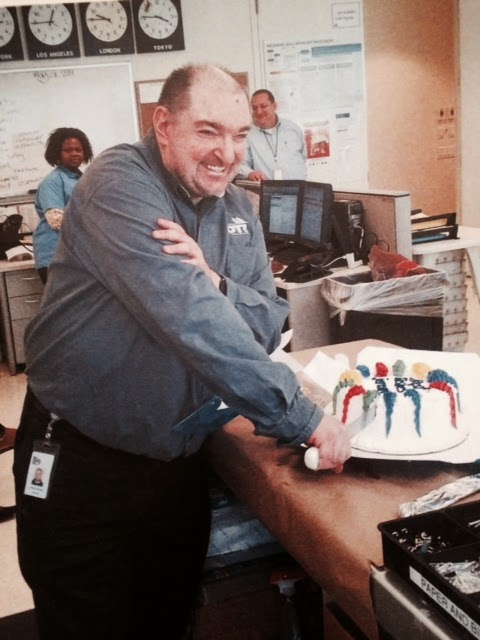
Over the last four days before his departure to Portland -- not including our family dinner -- Jeremy was thrown three parties: two by the staff of his regular bars and one by his colleagues in the mailroom, who pooled their money together and gave him a cake and $200: Jeremy's bonus after 12 loyal years working at the "Top Paying Company."  Some of the lawyers wished him well. 

During his final weekend, we dug out his small bedroom, a clown car, where he had accumulated 20 years worth of collections: 200 sports caps, 200 heavy metal and sports t-shirts, 150 NBA and NFL jerseys, 6 boxes of CDs, and 3 boxes of DVDs. In total we packed and lugged downstairs, ready for shipping, 49 boxes weighing over 700 pounds. Jeremy said we could toss the "rest of my stuff" after he was gone: 8 bags of heavy metal magazines and NYU girls' basketball programs (heavy stock, 4-color), and about 10 other bags of whatever.


Two Sundays ago, we saw Jeremy off at LaGuardia.   His mother had already found him a small apartment a few blocks from her own home, and she emailed us yesterday that he's worked out how to get around town, has registered to vote, and is going to an employment agency this week.  Once his extensive collections have arrived, and he has found a job and a local sports bar, I am confident he will settle into a regular life in Portland, as he did in New York, reliable and steady at work, noisy with team enthusiasm at the local sports bar, and impressing everyone there with his Stars Wars trivia expertise. We miss him.