Saturday, February 21, 2015

Building the Live-in Green Machine: Stage One

I've lived in apartments my entire adult life, and when we first started talking about building our own house, I pictured it pretty much like my kindergarten crayon house drawings.  Four walls, a pitched roof, windows blocked out in rectangles, and flowers with giant petals lined up under a Rothko strip of sky, a perky sun plastered to the right.  To build this early fantasy house, men would come in and lift up the walls and nail them against a frame.  I'd seen barn raising in movies. I know how it's done. 

This concept became a bit more complicated, but not by much, when we started looking at glass and steel modules designed by an architect in Minnesota and pre-made in a factory.  I envisioned trucks delivering three fully loaded house boxes, which a crane would surgically pick up and drop gently into place.  I'd walk in and start cooking.  I wasn't totally a house moron.  During college I had helped build sets one season at the Woodstock summer theater, so I knew that one had to look at floor plans and elevations to figure out where the futon and the bookcases would go.  So easy peasy.  

Wrong.  Building a new house, and particularly a green one, is constructing a machine, with nearly every element as complicated and inter-related as a Victorian steam engine. Screwing up one part can screw up everything, so Michael and I have to understand every inch of it – and we both have to agree on it all! 

Let's start with the boxes themselves.  There will be three: two floors of a main house and a guest house seated on top of a garage built on site.  The modules will be sided with Corten steel, a magic substance that begins rusting and then stops after a few months, the rusty layer then providing protection.  At that point, they will either look like Serra sculptures or abandoned warehouses In New Jersey.  

Next, comes the insulation that lines the boxes.  As it turns out, every builder has a different opinion on the best type and there are dozens.  We can have reflective insulating systems or fiberglass, mineral wool, and plastic or natural fibers that come rolled up in a blanket.  Foam boards can attach to the walls or foam or cellulose can be blown into them. Part of the decision on what to use relies on their R value, an equation that measures their ability to block heat conduction; the higher the value the better the insulation. The ideal R values vary depend on where you live, what kind of heat source your have, and whether you're insulating walls, ceiling, floors, or crawl spaces (we can skip those).  We found R-value calculators on the Great Google and were certain we wanted spray foam, which has great R numbers and seals a space beautifully, but the first factory bidding on our modules likes foam board and fiberglass all knitted together with tape. Another factory that comes in with a bid might prefer hay-stuffed walls.  Whatever wins has to be right.  After living through this winter in a barn with negative R values, I want a heat-holding insulation fist. 

Windows naturally leak air so you want those to have good R values too, triple pane being the best.  And with windows, it's not just their heat-trapping virtues, but where, how many, and what type they are. Michael would live in a glass box and I would live in a cave with a tiny skylight.  We have managed to suffer through this particular pane, but now another decision awaits us.  Windows no longer just go up and down, like the double hung of my youth. And they don't have to be rectangles. We can peer through round, peak or rake headed, Gothic, oval, or quadrilateral glass. They can fold out like awnings or shove out or pull in as casements. On the second floor we'll probably use the fabulous Loewen Access windows, whose gear mechanism has the complexity of an old-fashioned Swiss watch.  They twirl 180 degrees, go up, go down, and if we paid enough, could probably transport us into space. On the first floor, we might go for casement windows, but whether they push out or pull in is still up for grabs. 

And no one is ignoring what goes on inside those boxes. We spent a dispiriting day last week on IKEA Road in Paramus wandering among kitchen cabinets, clutching the plans we had made and printed out from the monster store's website after a few bitter fights over drawer sizes.  When I checked this particular IKEA branch out on Yelp, one short comment read: "It's where relationships come to die."  

By the way, it's astonishing how stupidly passionate one can get over whether kitchen cabinet doors should be white or off-white, or if a window should be pushed in or pulled out, or if the walkway is covered between two of the modules. I have been heard shrieking over whether an inside door should have one, four, or six panels, and before this process I didn't even know doors had panels. Fortunately, our marriage so far has weathered all these decisions.  

And next, we view the Green Giants, the systems that will support our house machine. The engineered flooring will conceal PEX coils snaking back and forth carrying radiant heat generated by an intricate collaboration between geothermal loops dug deep into the earth and solar electricity. To figure how much solar we will need we calculated the amount of kilowatts for every single electrical device -- large and small -- that we expect to be using in our new spaceship.  (The great Google has websites for doing that, too.)  I now know that at .18 per kilowatt the annual cost for my toaster is $25, for the two desktop computers it's $175, and my crockpot costs me $35.  However, geothermal will be the monster kilowatt sucking machine and will require about the same amount of electricity that we'll be using for the whole house.  So, that means we need two giant solar slabs, and they won't just lie there sunbathing on the roof.  Two trackers seated to the southeast of the house will move 40 solar panels back and forth, and up and down depending on the location of that perky sun moving across the sky.  

Yesterday we met with Pete, our contractor, who seems happy with the initial state of the architect's design and the general layout of the land.  Michael and I have reached agreement on the kitchen cabinets, the number of windows, the passage way between the main and guest house, and our solar slabs, which I believe will also find evidence of extraterrestrial life.  We opened a bottle of wine last night and celebrated the first stage of this adventure.  With luck, the snow will eventually melt and the digging can begin for stage two.

Friday, February 13, 2015

Winter Rules, Like It or Not

"I like winter here."
"Me too."
"I mean I really like winter here.  Not just tolerate it."
"Really?"  Coming from Michael, who was born and raised in Northern New Mexico, where winters can be cold, but are also dry, this was a totally unexpected preference. Snow around Albuquerque usually only laces the Sandias, looming to the East and framing a sky massive with dramatic and enveloping light, even during the shortest days.  Now, that's likeable.  Winters here in the upper Hudson valley are giant weather box stores, their long corrugated skies enclosing us in cold steely air, their aisles of road and short hills selling us nothing but cheap snow and ice.  I like winter here because I grew up in it and still bear those joy-loaded memories of no-school days and winter sports.  Michael mostly stays inside, except to venture out in the snow blower to clear our driveways and head to town for wine or dinner. So what's to like about winter in Hudson?  Some possibilities:

Checking the Weather.  Except in rare instances, weather in Manhattan serves only to create the day's wardrobe; here, it is the day. We check the weather obsessively – every few hours on three apps:  NOAA (the US weather service, which gives a week's worth of forecasting), Dark Skies (predicts our microclimate over the next few minutes through the following week), and Weatherlink (connects to a small station installed near our barn by Michael and our landlord/friend Dave that provides information on current and past weather right outside our door).  Weather's unpredictability here feeds my anxiety, which seems to be essential in keeping my rabbit mind alert, aware, and not bored. During my happy (no irony) decades in NYC, it was fed on dark streets by the antsy fear of bandits unmoored by expensive and brain-eating drugs. But after vigilant cops and cheap sleep-inducing heroin had softened up the streets, it was time to move where Mother Nature was the mugger, and my underlying anxiety could be constantly served by her acts of climate change vengeance.

Eating and Drinking and, If Not Merry, Being Less Sullen. Each morning I wake out of my daily bear-like slumber considering dinner.  Winter opens up my freezer, summer's treasure chest.  Out come the pureed pumpkin or butter beans for soup, or the long sweet green bean pods, bitter kale, or broccoli spig stems to accompany the roasts, or San Marzano tomato sauce for guilt-slathering on pasta, to dress the pre-grilled defrosted eggplant slices, or to thicken soups and stews, or, of course, packets of green New Mexico chilies, the fat thick ones to fill with cheese for rellenos or the messier thinner chilies to chop up into sauces.  No dinner is cooked without oil or butter.  Nor is it ever without a couple gleaming glasses of dry white wine.  The extra five pounds these winter meals bring are worth it (except for the falling-and-not-getting-up part).  Most nights we eat in by ourselves, but not every one, which brings me to the next winter routine, perhaps the most important one, and maybe why Michael likes winter. 

Seeing People Really or Virtually.  The darkest winter I ever spent was on an Air Force Base in Grand Forks, North Dakota, where its black rich loam was mixed with snow by the incessant wind snaking across the endless plain and oozed under doorways and windowsills as "snirt." Temperatures dropped to way past zero regularly, and it was against the law not to help a stalled traveler on those desolate highways.  I never had more fun or made better friends than I did that year.  Lesson learned for bad winters in Hudson. Good friends and family bring color and sound to this gray silent season, which make them even dearer than in the warm seasons, when we take their sensory effects for granted.   Roads permitting, I cook for friends at least once a week. Also, once or twice weekly we have dinner at DABA, sitting at the bar, listening to stories by the staff and other regulars.  I scrub potatoes and chop onions two mornings a week at the Salvation Army kitchen with some of the best and most interesting people I've ever met. Michael and I are also getting to know the eccentric indigenous members of our local loser political tribe.  And, once more with gratitude to the Internet, we connect regularly to our kids through email and messaging and skim the surface lives of our friends and relatives through Facebook.  And that brings me to the next likeable winter routine.

Browsing and Streaming.  We have no television, but the Internet and its fabulous device chums provide endless brain-numbing nearly guilt-free distraction during the long dark, cold evenings. I share with almost every woman I respect a love of grisly Northern European murder mysteries in all media: books, TV shows, movies available on Kindle, Netflix, Amazon Smile, Hulu, ITunes.  Michael enjoys browsing Ducati forums and looking at the latest trends in electric cars.  To our everlasting shame, we both watch streams of The Blacklist and Marvel's Agents of S.H.I.E.LD.  And his work and my occasional contracts are all screen based.  Most of our time then is spent indoors and most of that is staring at light disguised as characters and images.  We do, however, occasionally venture out and squint at actual light. 

Getting Outside and Playing in the Snow.  As a kid in upstate New York, I loved winter sports-- jumping moguls at inexpensive local ski areas, building bonfires next to a frozen pond for night skating, or gliding through woods after an ice storm. When we first started weekending up here, I bought skates for the pond across the road and cross-country skies for the hills outside the barn with the idea of reviving a chunk of my childhood. Unfortunately, over the past ten years, the pond has rarely provided a skin hard and clear enough for skating, and the snow is usually either too skimpy or too heavy for cross country skiing.  And, there's the falling thing.  

This year, sufficient snow has not been the problem, so last week I trapped my boots into my bindings and trudged off the sidewalk into the back yard drifts. Immediately, two feet of powder amputated the bottom half of my legs. With no visual cues for my skis, I dutifully wallowed forward on my knee stubs for about thirty feet. Ugh. Ick. Enough ski fun.  Turning, turning (very, very awkwardly) in the gyre and hoping the center would hold, I pushed back to the barn, finally popping my skis up over a tiny plowed bank beside the sidewalk. As I slowly slid off it, I lost balance. Gravity and age, having shaped my body into a plump pear, now, like Harry and/or David, seated it solidly into a soft gift box of snow. I couldn't get up and I couldn't shift position. I tried to release my binders with my poles but I couldn't get any leverage.  Fifteen feet away Michael was zooming about in the snow blower clearing the driveway, happily encased in the soundless, warm tractor cab. I thrashed, screamed, and waved my poles at him, but he remained oblivious, focused raptor-like on great shoots of ice and snow hurling to the side. (I think that's what he likes about winter.) I gave up and considered taking my boots off and walking in my socks back to the apartment, when he finally looked up, turned the engine off, and rescued me. 

So, probably no skating or skiing for the rest of this winter.  But there's a back up, not so much a winter sport as a chore. So that Michael and I can at least share something outside, I bought two sets of snowshoes, tepid sources of fun, but it's really hard to fall over in them and they do fulfill the dreary exercise requirement.  So a couple days ago we trudged on our Yeti feet down to the future building site and tracked into the snow the outline for our imaginary house and pond. And that was very likeable, and leads to the next more likeable winter activity.

Planning the House, Meadow, and Garden.  During this Arctic winter, we have spent some of its time anticipating the New House, fiddling with our architect's revisions and our engineer's ideas for the curves of our driveway and pond. Hope for green energy glimmers from calls to solar providers and consults with an HVAC expert (also a neighbor) on radiant heat and geothermal loops.  Even better, an email from Barbara, our wild flower meadow consultant, says it's not too early to start thinking about buying seed. In fact, I already have the seeds to my vegetable garden and I'm updating last year's notes.  I can't think about these things too much, however, because they tend to produce delight and excitement in the future, which then replace my chronic anxiety and pessimism, which, I believe, are essential for a truly happy life. Which brings me to my final likeable winter routine.

Meditating or, Anyway, Sitting Still. Winter slows time.  Which can be annoying, as in, "God, when will this ever end?"  But it can also be a comfort for those of us who now measure it out carefully. A winter day may be boosted by a singular event (soup kitchen, dinner at DABA, a political meeting, a consult on the future house, cooking for friends, long phone call with kids) but it is always surrounded by silence or it may be determined only by silence. During the day Michael and I rarely add additional sound to its soft white stillness while we're in the apartment working, browsing, or streaming. I also may meditate for a half hour or so in the early morning, ideally with my cat Killick curled up within my inadequately opened lotus.  This daily mental experience of absorbing winter's soundlessness and lack of light brings me closer to death's neighborhood but paradoxically reduces my chronic anxiety about life's end (which, of course, is what all my anxiety is or ever has been about) and even suggests joy – not the dithery anticipatory hobgoblin delight of my youth – but something subtle and underlying, vaguely resonating light and affection, something simply good lurking just beneath the cold and the dark.


We're now up to a couple feet of snow covering a nice thick bed of ice.  We just dodged a sleet/ice-storm bullet and anticipate a weekend of subzero temperatures and "life-threatening" winds.  As long as the power in the barn holds, what's not to like?

Tuesday, January 27, 2015

Mabel, Me, and Sacred Houses

"What if it bleeds?" It was four in the morning. I reached over in the dark to the bedside table and clawed my trusty I6 toward me. Pulling the covers over my head so I wouldn't wake Michael, I Googled "living in a house made of Corten steel." Last week the penultimate design and budget for our house came in, the costs already over our original plan, with the only construction so far --  outside our architect's CAD program -- being a hole for the perc test to establish our septic field location. What if the Corten process doesn't work and the walls corrode into Swiss cheese before we get a chance to die and don't have the money to fix them?  What if it's like living in a drum?  What if it oozes rust all over the ground like some wounded robot? What about lightning?  What if it isn't sacred like Mabel Dodge Luhan's house? Because this is the house I really want.  I want a sacred house.  I want her house.

Mabel Dodge Luhan's adobe home was built around 1920 on the edge of Taos by her husband Tony Luhan, a Pueblo Indian, using no metal at all. The house appears to have been planted and grown from the New Mexican earth, a fairy tale string of adobe rooms tumbling off a central three-story structure, which holds Mabel and Tony's former bedrooms, the kitchen, and a cluster of small common rooms, warmed by the warm round bodies of kiva fireplaces.  The house survived ownership in the 1960s by Dennis Hopper and, now safely listed in the Historic Register, is a bed and breakfast with most of the furnishings and structures intact. 
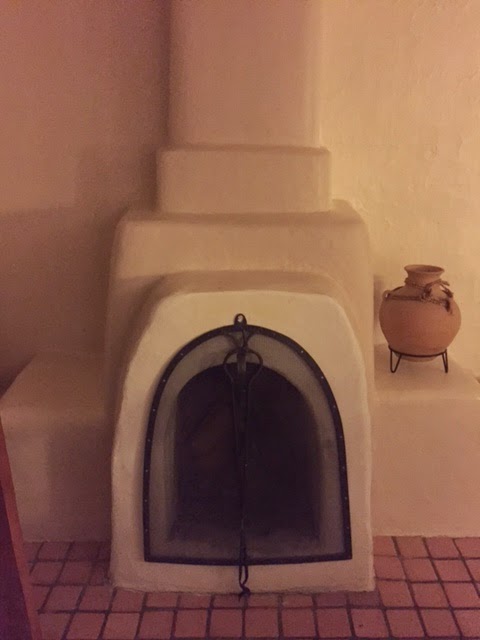
 Mabel has been an alluring presence in my life since I was an upstate teenager reading a book about Greenwich Village in the early 20th century.  The author described Mabel then-just-Dodge as a wealthy divorcee who held salons for all the famous writers, artists, and radicals of that time, whom I imagined sitting in her living room, drinking something dangerous, and being funny, wise, and socialist. I read this book in the late 1950's when Mabel was still alive.  I knew nothing of her subsequent home in Taos, New Mexico, where she died in 1962, and didn't for another thirty years.  At that time, I just wanted to be in New York, in the Village, in that apartment. And I didn't just want to be like Mabel Dodge.  I wanted to be her.
 
Mabel had been born rich and married richer twice before she started her New York salon. During that period, between lovers and trips to Paris and California, she married her third husband, the painter Maurice Stern, who, well-meaning but dim-witted, suggested that Mabel check out New Mexico and save Indians. So she went West and met Tony Luhan, a native of Taos Pueblo, whom she snapped up as her fourth husband, saving this Indian at least for herself and dumping Stern.  Tony built Mabel her wonderful adobe home, where she set herself up once again to attract even more artists and writers, this time to Taos, including D.H. Lawrence, Ansel Adams, Willa Cather, and George O'Keefe.
Judging from the old black and white photos of Mabel, it's difficult to imagine her seducing all those amazing men, not only her various husbands, but her many male and female lovers. Strong jawed, with banged-up flat-cut hair and androgynous outfits, Mabel was described by Georgia O'Keefe (who, to be fair, was at one point a rival for Tony – an unrepentant philanderer) as talkative and overbearing.  During one of her psychiatric sessions, Mabel  was advised by a Jungian analyst to control her overactive animus.

Although spending most of her time in Taos, Mabel still schlepped back in forth between east and west and remained a citiot.  She regarded the local Hispanics as "fatalistic, shiftless, and driven in their religious rites by masochism," while they were put off by her affairs and multiple marriages and the rumor that she was responsible for the invasive sunflowers, brought from the east and overwhelming their crops. Although Mabel became involved in conserving tribal culture, Tony told her at one point that "Indians didn't like her either". Mabel described their relationship with her as being "merely polite or not even polite with me, indifferent  – apart – as though leaving me to stew in my own poison."
Nevertheless, her own writings suggest a woman trying very hard to dope things out within the context of her own culture and time and seeking to think beyond their barriers. Her writing is observant, reflective, and she doesn't hesitate to make fun of herself and her own behavior. After reading them, I still wanted to be like her.

Michael grew up in Albuquerque and after we met in the late eighties, I went with him to New Mexico for the first time.  It was August, and we drove north to Taos and stayed at Mabel's house. I was having difficulties dealing with my corporate life at the time, running a failing division that I couldn't kick back into the previous and now impossible level of profitability desired by my masters. I took my spreadsheet (paper at that time) with its nasty numbers out onto the patio in front of Mabel's adobe building, and fretted over their inability to levitate.   And, then, suddenly those numbers did.  They drifted up out of my consciousness and dissolved into that shockingly clear blue sky. The suffocating noose of anxiety released, no longer knotted by the cultural fallacy of the Hallowed Career.  I breathed in. I was at once done with this life. It took me another couple years to find the work I wanted, but it began there, in Mabel Dodge's sacred front yard.

This year over Christmas week, we reserved four rooms there, including Mabel's bedroom for ourselves, to celebrate our 25th anniversary. We managed to corral 4 out of 5 offspring and 2 out of 5 grand offspring to come with us.  Scattered among Mabel's and Tony's adobe rooms and cottage for two days and nights, our discordant but wonderful family sat by the many kivas, constantly fired up to warm the bedrooms and the small, magically comfortable common rooms, talking religion, politics, and movies and celebrating our anniversary.  We only left to eat at night in town or to walk (illegally) during the day out of the back gate on to the snowy desert owned by the Taos Pueblo, throwing snowballs and listening in vain for the hum from the Magic Mountains. With nine extended family members glued at the hip we did pretty well.  Everyone is still talking to each other. The only downside, Michael and I couldn't use the bathroom adjoining Mabel's bedroom, where the sun still plays through D.H. Lawrence's skill-less playful paintings that he splashed across the windows.  This belonged to the lucky guests who took Tony's room above Mabel's, where a skylight over his bed opened up to the stars. 

Driving back to Albuquerque down the state highway between the steep sides of its bluff with their harrowing boulders about to lurch down on our heads, we emerged from them to confront the huge sky rising across the desert.  I thought, "So, I could live here." But I don't.  I live in Hudson.  It's too late for Taos.


In some ways, though, I've lived a Mabelish life. Like her, at times a total jerk and without being a great beauty, I've been multi-married with more than my share of affairs and at one point could have been accused of having an overactive animus.  If I haven't run salons for famous artists, I've fed dinner to a number of funny smart people.  I've left the city to create a more natural life, and my third husband may even have a bit of Apache in his DNA. The house that we're building will rest in a hollow, and even though it's not next to a reservation, it will be the neighbor to Olana, Frederick Church's estate with its Victorian folly overlooking the Hudson River and our tract of preserved land.  Our house will be made of steel and glass – not mud -- but we'll have solar electricity and geo-thermal heat. And the steel is Corten, which will react with the sun and the rain so its surface will rust, a mottled sienna color like the earth, protecting the walls and rooms within it.  Maybe it will be sacred in a funky techie way. Maybe Mabel and Tony would have liked it. In any case, we'll have lightning rods. 

Sunday, November 23, 2014

A Tribute to Upstate Goulash

I walked into the Salvation Army soup kitchen on Friday morning, my weekly volunteer job, to see Sue, the cook, stirring up a huge vat of tomato and meat sauce, with several boxes of macaroni sitting on the counter.  "What do you call that?" I asked her. 

"Goulash," this lifelong upstate New Yorker said.

Ha! I knew it.

Maybe one reason (among many) that I’m not a famous chef is that the only family recipe that traveled from my grandmother, to her daughters and to theirs and to theirs is goulash. And we're not talking Hungarian. This is Upstate New York Goulash, a dish reflecting the lack of interest of generations of American women who live in the colder and flatter states in spending a lot of time in the kitchen.  This was the only dish a couple of my two dozen cousins remember my grandmother cooking.  (I never saw her cook anything.)  She had six daughters who took up that slack, and, as soon my mother -- one of those daughters -- could, she passed the goulash torch on to me. I was thirteen, it was the first dinner I ever made, and it wasn't tricky:  brown one pound of ground chuck (don't bother throwing out the grease); add one chopped onion, one can of Heinz tomato sauce, one can of Heinz tomato paste, garlic salt, dried oregano, dried thyme, salt and pepper, water.  Boil a pound of dried macaroni.  Throw everything together.  Serve.  I felt triumphant.  My pleasure in making this dish way surpassed the modest experience of eating it, but it set up a lifelong devotion to tomato sauce and whatever pal was around to absorb it.  And Upstate Goulash launched my love of cooking.

Although of course the origin for this dish is Italian, a recent article in the New Yorker provided some evidence that this variant originated in the WASPier parts of the Old Country. John Lanchester, a British novelist and former food writer, opened up his article "Shut up and Eat" with a description of "spag bol," the first recipe his mother gave him.  It was the essence of Upstate Goulash: a blend of "meat ragu of a northern-Italian type with the dry pasta beloved in the south."  He went on to write that spag bol was "sometimes said to be Britain's national dish."   Not fish and chips.  Not marmite.  But my very own comfort food, rerouted from Italy to the States via England, and like any British colonial territory, subdued during this process into a polite blandness.

As further proof of the indigenous aspect of this dish, a week or so ago, Michael, and I were driving with friends through Spencertown, about a half hour northeast of Hudson, and we spotted Dan's Diner, a beautifully restored relic that looks like a time machine.  The sign outside it read "Todays Special.  Goulash." 

"We have to have lunch there!" I yelled.  "I have to see if this is Upstate Goulash!" 

The diner was great looking and it was lunchtime, so everyone was agreeable. There were no tables, just two counters, one stretching underneath the window and the other overlooking the service area, where we chose to sit.  We beaded ourselves onto authentic but pretty uncomfortable wooden stools, and I peered over the edge of the counter at a large plastic bowl that I knew immediately contained the goulash of my childhood, macaroni and meat sauce.

I could lie here and say I ordered it and that it was a Proustian moment, but I had a very nice Reuben sandwich instead.  Let's face it, over the years I have retrograded the Upstate Goulash back into its much, much tastier Italian origins. The omphalos of my vegetable garden is the Roma tomato -- San Marzano and Scattalone -- around which grow things that adorn it, green chilies and eggplant, cilantro and basil.  I roast the tomatoes on the grill and process them. I cook the sauce for hours, studded with sautéed garlic, onions, and some chopped green chilies, before adding fresh basil at the end and freezing it for the winter.  The sauce is later defrosted and adjusted with other stuff -- red wine, rich stocks, mushrooms, sausage -- and then poured over, not only pasta, but eggplant, crepes, stews, and soups. 

At my sister's birthday party last week, we watched Jim, her boyfriend, make fresh linguini from scratch as a nest for a rich ragu, which included cream and chicken livers among its fabulousness.  I watched those long curls of linguini drift off of Michael's hand as Jim gently guided patches of shiny dough into his gleaming Atlas machine and wound the crank.  I went home, clicked on Amazon, and bought one. Another way of extending my favorite dish.  

Lanchester is somewhat uneasy, as I am, with our cultural obsession with food, how it's made, how it's cooked, and the current trends in food celebrity. (Is there really a problem believing that Bobby Flay beats George Clooney as the sexiest man alive?)  But even before the food rage started, I have loved cooking and all media related to it. I read cookbooks as if they were novels, starting with my mother's battered Boston Cookbook through those written by the wonderful Childs, Hazen, Wofford, and Kennedy.  I have watched cooking shows for decades the way guys watch sports; Julia Childs and the alcoholic Galloping Gourmet helped me get through a year in the mid-sixties on an Air Force base in Grand Forks. I’m not sure there's a morning during my entire adult life, which now stretches over half a century, when I haven't woken up thinking about what I would cook that night. And, even better, if what I’m cooking draws in lots of people.  Since I've moved up to Hudson, my wake-up list during the spring and summer now includes what I'm growing and in the fall what I'm processing. Even my volunteer work involves a soup kitchen and food pantry.  Cooking is therapy during sad hours and my healthy response to happy ones.

Those of us who binge on Chopped should not beat ourselves up; food is a natural obsession.  We're animals and as part of those souls, we are always looking to graze, hunt, and forage. I'm not a chef.  I'm one of zillions of women now and back into the caves who throw meat on the fire and grains in the pot for their families and, with luck, for some hungry Neanderthals who wander by.  And making that food taste better and showing other cooks how is as primal as singing and dancing around that fire pit.  It's an entirely lovable process.

Lanchester ends his article, which is mostly about the American food obsession over the past three decades, by telling the reader that he would be cooking spag bol that night "for the zillionth time."  Like me, he has offered up hundreds of variations with more depth and taste, but he always comes back to his mother's version: "onion, ground beef, tomato paste, canned tomatoes, wine, thyme, salt, a minimum of three hours’ cooking."  And his final wonderful tribute to his mother defines precisely what Upstate Goulash and this whole lifetime of cooking has meant to me: "She didn’t think she was saving the world by cooking. But she did know that it was part of the process by which she saved herself."