Saturday, July 26, 2014

Under the Hudson Sun

Frances Mayes, in her book, Under the Tuscan Sun, included a recipe for bean soup that used Tuscan kale, with a description of those dusk-green leaves that lured me into choosing it among the first vegetables planted in my Hudson garden. I made the bean soup, which was glorious, and, when sautéed, the kale's dark chewy taste lightened up with olive oil and garlic. Soon kale replaced the ironclad spinach, which was never really welcome in my home anyway.  Also, joy, I discovered that I can keep harvesting kale throughout the summer and into the fall by amputating it's bottom leaves, similar to those African cattle ranchers who lop off pieces of cow thigh for dinner without killing the animal.  (I had only heard this story anecdotally and when I tried to verify it using Google, I couldn't find anything.  Oh well.)  I have grown kale now for years, and when crazed chefs started kneading it as preparation for salads, laughably sweetened with dates and cranberries, I too succumbed to the kale massage, squeezing and mushing those muscle bound leaves with olive oil, garlic, and lemon (no added fruity treats, however).  And although I tricked myself into believing I could actually soften up those beautiful raw paint chips, when I started serving salads to friends the confessions began to roll out. "I hate kale." "Please don't serve kale."  "Kale is horrible!"

Well, my friends, do I have the crucifer for you!  Broccoli spigariello liscia, the next contender in the latest dreary battle to make the tough so-good-for-you greens edible.  I planted this broccoli last year and waited and waited, until, after weeks, tiny little florets sprung out from the ends of the plant. They were very tender and sweet, much tastier than their lunky solo broccoli cousin. I subsequently learned that you can munch on the spigariello leaves during the summer while waiting for the tasty bits to appear.  I cut my first leaf crop last night and sautéed it with garlic.  Disappointing.  Flat and bland, although I learned today that I should have cooked the stems with them and that they taste better than the leaves. My favorite local chef also said to immerse spigariello in ice water first. I'll try again. But it might be worth it just to wait for the florets.

In any case, I am a sucker for Italian seeds and their names.  Currently in my garden, in addition to the spigariello broccoli, are the Italian beans di Spagna bianca, lingua di fuoco, and cosse violetto sans fil.   And I'm convinced that the Hudson Valley, with its current influx of fanatical grower and cooker locavore immigrants, can become an Eastern Tuscany.  Unfortunately, as long as we can't grow artichokes or make drinkable wine, Northern California will always beat us in the US Italian Wannabe contest, and I doubt rutabagas and hard cider will ever offer any gastronomical competitive advantage. Nevertheless, our river valley is beautiful and given even modestly good weather, our rocky soil throws up some very mean veggies and fattens many happy, sometimes tender, cows and pigs.

There are problems with my Mediterranean vision, of course.  Aside from Hudson Valley's chronic climatic inferiority to Napa, Columbia County is the second least protected county in the state, meaning no zoning, which perpetuates an underlying anxiety.  For-sale signs tart up every major highway, exposing voluptuous virgin acres of forest and fields with vulgar enticements: "Great for Commercial Property."   To keep the cement plants and big box stores down to a minimum, we rely on our very active conservationists and a small fraction of Manhattan's one-percenters to procure land for preservation or agriculture. The salaries Michael and I made have been close enough to the one-percent so that we could afford not only to buy a chunk of land but also to conserve it. 

Weighing in on the conscience, however, is the local 99%, who suffer steady unemployment rates. I see some of them during lunch time at the Salvation Army soup kitchen, and I'm sure they would welcome a cement plant or two and a slew of bb stores.  That much of the produce they eat at the SA kitchen is organic and donated from local farms and that in my Chianti-manqué utopia their work opportunities might be limited to farm laboring might not be as exciting for them as it is for me. Still, the alternative is to beat up the landscape for the sake of jobs that barely support their kids on platefuls of sugar and carcinogens and that end up giving them repetitive stress injuries, chronic low back pain, and no happiness.  

The cultural values of ourselves, town, county, valley, state, country are fractals on America's construct that are currently the endless iterations of the right-left, rich-poor tension, continually forming patterns that repeat at every scale. I believe events will eventually converge to break those tense lines into some different pattern, I hope from some positive outcome of our chronically crazy democratic anarchy and not from violence.  Where we land as individuals within this geometric flux will mostly likely, as usual, be a matter of luck and opportunity, rather than free will. And, for better or worse, I'm hoping that when that convergence occurs that the fractal patterns repeating around and within us will be shaped, not like Paramus, but like Tuscany, where a less sick growth-minded culture allows two hour lunches with glasses of dry apple jack, where work intensifies and pauses with the seasons, and the word "consumer" has become politically incorrect.  More spigariello liscia, anyone?

Sunday, July 6, 2014

I'm in the Army Now

Like many retirees, I’m looking for a way to "give back" after years of having given very little to the world except my terrific kids and a couple of useful medical articles.  I don't want to work in an office ever again.  I have no house building skills and I can't teach anyone to read. I have, however, always wanted to work in a soup kitchen, which combines cooking, feeding people, and feeling virtuous (nothing wrong with that, by the way).  On our way into Hudson, we pass the Salvation Army Center, a rather grim little building right on the edge of town and five minutes from the barn, which offers lunch Tuesday through Friday.  I Googled it and found they needed volunteers. Perfect, for in addition to having a soup kitchen, the Sally Army is meaningful for me in two other ways,

First, the SA was the only charity that my father donated to, because, as he told me when I was about eleven, "They didn't charge soldiers for donuts during World War II while the Red Cross did."  My father was never in the military, so he most likely got that information from his brother Bill, less than a year older than my Dad, who was killed in a tank unit at the Battle of the Bulge.  That Christmas I made my first donation ever: 10 cents tossed into the metal bucket of an SA bell ringer outside Woolworth's in Troy. I have given to the Army ever since, naturally with increasing amounts.  

Second, my very first job in New York City was in 1962 as a bag lady for the SA during my college freshman work term.  I worked for two pleasant women at the Barclay Hotel on 48th Street, where the Army rented a suite.  For a weekly salary of $45, I filled little sacks with donation items and delivered them to high-end spots -- Bergdorf, Bendel, Twenty-one, Saks, Sardis -- where wealthy women who wanted Junior League credits picked them up and collected money from their friends. Bell ringers, but silent and golden. At night I joined my roommate in a one-room apartment with shiny turquoise walls on 9 West 84th Street. We split an exorbitant rent of $100 a month for a place a block from the city's heroin center between Columbus and Amsterdam. We were broken into only once and it was the best time of my life. After that winter, NYC was my soul city. 

So three weeks ago I called Jill, the manager of the Hudson SA center, who said, "Yeah. Sure.  Come on in when you feel like it."  Encouraged by this casual acceptance I wandered in the next Wednesday and committed to work one day a week from 8 to one.

Because the Army, like most traditional churches these days, has experienced a continual decline in membership, it is testing out using some centers just for service, with no mission/evangelical efforts.  The Hudson SA center is the first in the state to be set up this way. Jill, who runs it, is Catholic and reports to an Army officer in Albany, who pretty much lets her run the center the way she wants.  And for good reason.  Jill has achieved a nearly impossible feat; her center makes money.  The revenues come from local Christmas bell-ringers -- business men, real estate agents, kids -- anybody that Jill can badger into volunteering. And, she gets so much food from local businesses and farms that she almost never has to resort to using her funds for buying any. So she makes a profit, which she hopes to use for new projects.

Jill is blonde, tough, attractive, funny, competent, and kind without being wimpy.  She should be everyone's boss. Four others typically work regularly at the center. Kevin and Sue are the cooks.  George and Charlie, who serve the lunches, lug boxes, wash floors and do anything else that's needed, are short, self-deprecating, kind, and always helpful, sort of like Santa's elves grown old.

When I first arrive at 8:00, I enter the dining area, a dowdy room, but pleasant and full of light, with four long tables, each set with 12 small fists of paper napkins wrapped around plastic utensils, and two empty tables waiting for the daily food deliveries. The SA kitchen opens off the dining room, a sketch of a small-town restaurant -- a big black stove, lots of huge cauldrons and monster bowls lining the shelves, back rooms with stacks of cans and boxes, cold storage areas piled with produce, and freezers full of ham, chicken, and beef. 

Jill and the cooks have already been there for about an hour, and if roasted meat is on the menu that day, it is already in the oven.   Kevin typically does the meat and likes to describe the marinades and rubs that he uses.  Once he puts his roasts in the oven, for the rest of the morning, punctuated by the occasional cigarette break, he tells stories about his past, describes his many unfinished projects, and complains about his Lyme disease to anyone who will listen. Kevin has been at the SA center for four years,  now on salary but originally assigned there by the Department of Social Services (DSS). He is a paradigm of how the sixties shaped and hammered its flower children into old age.  He has the apple belly and worn looking face from a life of too much booze and too many mind altering drugs providing too many unsubstantiated dreams; he's down but not yet out.

Sue is salaried and does all the rest of the cooking plus scullery duties. She is a straightforward, smart single mother, who works through chronic pain unrelieved by two previous non-helpful spinal and cervical surgeries.

Unless they are making salad that day, which requires a lot of chopping, I generally hang around listening to Kevin's stories until Sue and either George or Charlie return in the van from Walmart and Hannaford, where they have picked up boxes of donated meat, produce, and various baked and dry goods. Occasionally local farms send in fresh vegetables as well, Everything that comes in is weighed and recorded (sometimes my job), and then stored.  If the center can't store, cook, or pass all the food out at the weekly pantry, Jill has a call list of local churches and other charities that take the extra food.  Nothing is wasted.  A near-by farmer even collects the moldy bread for his live stock.

Around 11:30 the clients begin to wander in until lunch closes at 12:30 -- between 30 and 60 older white and black men and women, with a couple mothers and kids.  If Jill had a motto, it would be Zero Intolerance.  Anyone can eat there.  All you have to do is  walk in.  There are no conditions, requirements, or questions.  No one who works there preaches, and no one patronizes. (A few of the workers have been assigned from the DSS and are themselves only a step away from sitting at one of the tables.)  A food pantry is set up on Fridays and the diners can take home extra food that day after they eat.  Sue and Kevin also make a second full meal on Thursday for a local senior center.

So far this may be the best job I've ever had and if I can shrug off some of my essential lethargy, I might do more time. I'm not used to working in a place where no one is clutching their territory or eyeing a vice presidency with fearful resentment and where being of service is the only motivation.   I'm not sure I'm very useful, but I seem to be able to fill in on menial tasks. I found that none of the men will wash dishes, so at least I can do that, a mini-me scrubbing those huge pots and pans. I can also chop vegetables,  and last week, I nearly made the rice.  Maybe next Christmas, I'll join the volunteers who haunt every store in town throughout the season, puffing out steam, pink-cheeked, and frozen, a thick glove swinging the annoying persistent bell, and urging kids to put their first dimes through the wire screen of the metal bucket. 

Friday, June 13, 2014

The Emptying Nest: One Flew Off to Portland

After fifty years of housing children, the last nest is about to be emptied out.  My son Will and stepson Jeremy have been living with us since we bought the apartment.  Will is staying until the end of June. Jeremy flew off last week.
Our NY living room. Jeremy on the left, Willie on the right. 
Jeremy was labeled with learning difficulties as a little kid, which set him on a middle class LD education and career track: special ed programs in his New Jersey suburban public school, Winston Prep high school in New York, then NYIT, a tech college that provides basic social skills and training for jobs.  After Jeremy left school, he found work through VESID, a New York program that helps adults with disabilities find a job. Jeremy's was in a mailroom, managed by a contractor to major corporations for office services.  He held this job for 20 years, surviving recessions and several changes in both his contracting agencies and the businesses they contracted with.  He has been the most consistently employed of all our kids.

Over the years, Jeremy also carved out a satisfying social life for himself at a couple local Irish bars, where he hung out regularly on the weekends, drinking a few beers and wearing different sports caps and jerseys depending on the favorite team in that night's big game.  At home, during the weeknights he typically watched a game on TV or his DVDs (James Bond and Star Wars being consistent favorites) or listened to CDs (mostly heavy metal, but he also was drawn to the Three Tenors and Yanni).  He kept in touch with some friends from his previous schools, who lived in other cities and whom he occasionally visited.

For the last 12 years, Jeremy was indentured through his contractor to Bingham McCutchen, a global law firm. He got up every morning at 5:00 AM and went off to open up the offices, where he delivered the lawyers' mail, did heavy lifting, and worked with his colleagues to make sure the highly billable packages and documents moved in and out of the offices smoothly.  He was regular as a clock, almost never got sick, and took only 3 weeks vacation.  (Because of the changes in contracting agencies, his vacation rebooted with every transition, so after 20 years of steady work, he had accumulated only this amount of time off.) 

According to Wikipedia, Bingham McCutchen placed among the top 5 in Fortune Magazine's "Top-Paying Companies" every year since 2006, peaking at #1 in 2013, 2009, and 2008." Until the last two years of working there, Jeremy was only making minimum wage. The contracting company finally gave him a raise, but after deducting health benefits and taxes, he still probably netted only about $17,000 a year  

Jeremy hadn't wanted to leave New York but there was no way his income could have supported even a small apartment in the boroughs.  He didn't want a roommate and he definitely didn't want to go to Hudson. The only option left was to move to Portland where his mother and stepfather live.
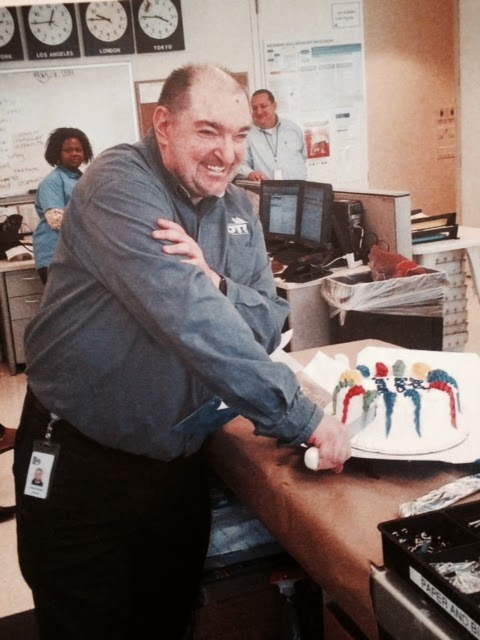
Over the last four days before his departure to Portland -- not including our family dinner -- Jeremy was thrown three parties: two by the staff of his regular bars and one by his colleagues in the mailroom, who pooled their money together and gave him a cake and $200: Jeremy's bonus after 12 loyal years working at the "Top Paying Company."  Some of the lawyers wished him well. 

During his final weekend, we dug out his small bedroom, a clown car, where he had accumulated 20 years worth of collections: 200 sports caps, 200 heavy metal and sports t-shirts, 150 NBA and NFL jerseys, 6 boxes of CDs, and 3 boxes of DVDs. In total we packed and lugged downstairs, ready for shipping, 49 boxes weighing over 700 pounds. Jeremy said we could toss the "rest of my stuff" after he was gone: 8 bags of heavy metal magazines and NYU girls' basketball programs (heavy stock, 4-color), and about 10 other bags of whatever.


Two Sundays ago, we saw Jeremy off at LaGuardia.   His mother had already found him a small apartment a few blocks from her own home, and she emailed us yesterday that he's worked out how to get around town, has registered to vote, and is going to an employment agency this week.  Once his extensive collections have arrived, and he has found a job and a local sports bar, I am confident he will settle into a regular life in Portland, as he did in New York, reliable and steady at work, noisy with team enthusiasm at the local sports bar, and impressing everyone there with his Stars Wars trivia expertise. We miss him.

Monday, May 26, 2014

Rating My Career Through Its Office Spaces: 1962 to the Present

1962 (Winter).  Most depressing office space.  Troy Welfare Department, A tiny steel windowless office with one steel desk and one steel cabinet. It was set in the middle of a storage area that served the floor where indigent nursing home patients slowly died. I was 19 and a Bennington freshman and this was the only job I could find during our non-resident working term.  My best friend had died right before Christmas in a fire. During the next two months in that terrible space, I recorded inventory items on index cards: house dresses, bathrobes, caps, and floppy slippers.  For an hour in the morning I added those that had come in and for an hour in the evening I subtracted those that went out. At lunch I ate a sandwich in a small room a few feet from the storage area with three or four other Welfare Department workers, all older women who had worked there for centuries.  During the rest of the day, I read Kafka and Camus and considered the meaninglessness of my life, terrified both of dying and particularly of dying without losing my virginity. 

1973.  Scariest office space.  Frontlash. A small office on 19th Street and Third Ave., where I served as administrative assistant for the sour vice president of a Social Democrats (SD) front that organized voter registration drives for the unions. A single mother with my small son and daughter living in Manhattan, this was my first job after five years as an Air Force wife.  Being anti-war and ignorantly left wing, I was excited about working for a socialist organization, until I unhappily learned that, although great on civil rights and unions, SD was anti-communist to the extent that it supported the Viet Nam war.  Except for occasional volunteers and a part-time secretary, the staff consisted only of me and my boss, who ran the tiny organization as if it were US Steel.  Although only three feet away in her own office, she buzzed my intercom when she wanted to talk, usually about how to underpay the secretary or berating me for spending my free time trying to prevent the closure of my day care center.   Our office adjoined the League for Industrial Democracy (LID), another SD front, where three other women worked (I don't know what it did).  The neighborhood was shabby and little desolate, and one afternoon, with my boss gone, a young man came through the door pretending to be looking for design work.  Instead, however, he ushered me into the LID offices, where his partner was standing over its staff lying on the floor, tied and gagged. I joined them, tape across my mouth, feeling the cold tile under my cheek, repeating silently over and over as they went through our desks, collecting our meager $25 in petty cash, "Get out, get out, get out, get out." (My response to danger, I learned then, is possum-like.) I was glad my boss wasn't there.  I'm sure she would have gotten us killed.  Frontlash moved to Washington DC a few months later, leaving me unemployed. Secretary jobs were easy to get, however, and my only criterion for the next one was to have it uptown, working for a kind boss, which I did, an elderly economist at the National Bureau of Economic Research, where I spend a pleasant few years and helped organize a union there.

1978 - 1980:  Only time I cried over office space.  Scientific American.  Started as a secretary in 1975, when everyone in this benevolent company had their own office.  Expansion of the company forced me into the hall manning a desk outside my boss's office, feeling so degraded that I wept all day (little did I know that cubes that awaited me in my future).  Nevertheless, I typed out two novels during that period of exposure and was promoted and eventually moved back into an enclosed space.  Ended up not being so bad.

1982-1991.  Best office space. Scientific American. A corner office on Madison and 48th on the 11th floor, where I had a view of Rockefeller Center until a developer constructed a large building between us that eventually obstructed the view.   I spent the years in that splendid office, first as production manager of a very small division that produced loose-leaf medical texts, then its publisher, and finally a vice president within the company itself.  While serving as production manager, I became pregnant with Willie, my youngest son.  Instead of taking the full six-month maternity leave, I returned early and built a nest in the corner of my office, where my infant slept and whom I nursed while discussing paper and print jobs with good natured, tolerant sales reps. Promoted to publisher, I discovered the obsessive joys of working with electronic spreadsheets and entered with my wonderful crew the brave new world of electronic publishing.  Reluctantly making me a vice president of Scientific America in 1984, my new German bosses referred to my management style as Snow White and the 21 Dwarfs.  We struggled, without comprehending each other, for a few years, happily parting company in 1991.

1992-2004. Happiest office space.  Home office. A carved out corner of our apartment, where my Mac, my partner, and I built a small business over the course of ten years and I gave myself an education in web design, print-layout, and medicine. I finally was able to write mysteries that got published -- 102 cases on common diseases, which my partner sold as print and electronic patient information to medical libraries and the growing body of on-line medical sites.  Various cats sat in a basket next my computer, only occasionally stepping on the keyboard.  Michael and my older son Geoff worked a block away and would come home occasionally for lunch.  I was there every day when Willie came home from school, who commented at one point, "Mom, why don't you work in an office like other moms?" It was the best time.

2006-2008.   Most beautiful office space.  WebMD/Medscape. A large open cube protruding at the end of a row of other cubes. Back into corporate life after selling our business for shares, which subsequently tanked, I worked as an editorial director for Medscape, the professional side of WebMD, and was surprisingly content. The offices were downtown in the Meatpacking district, and the editorial group, although perched in cubes, was set apart from the rest of the company, and my cube was set apart from my colleagues.  When I swung my chair around, I looked out along a sweep of windows that provided a view of all lower Manhattan, which included a very tiny Statue of Liberty.  The drama of storms and sunsets coming across the Hudson far compensated for my small cubal area. 

2009-2013. Most absurd and worst office space. WebMD/Medscape. Total cube land, built on the hypocritical premise that it would increase communication and spur creativity, when actually it was designed, like pig farms, to save money. They had moved the editors uptown to 50th and 8th Avenue, where even managers were lodged in cubes, so talking spontaneously and confidentially with your boss became impossible. No privacy (phone calls heard by all, computer screen revealed to all who passed), absence exposure so lunch gobbled at ones desk between keystrokes, the only creative communication with colleagues being the occasional gophering (heads pop up above the cube wall, noises made, then shushed down by everyone on the vast floor), and continual distraction by others goffering or appearing suddenly and frighteningly behind your back wanting to communicate something. Upon standing up, the view was a despairing landscape of rectangles, beyond which windows looked out on an equally despairing landscape of corporate buildings.  Everyone wanted to work at home.  


2014. A room with a view: Art Science Code. Back to the home office, this time with windows and sporadic hours.  I'm a partner in Art Science Code, with my other two being Michael and Geoff.   Work doesn't pay much but involves this blog, my unpublished novels, Facebook time, and the occasional welcome contract from Medscape. 

Thursday, May 15, 2014

The Body in the Barn

A white van has been parked all day outside the huge apple barn that supports our apartment off of its south side. Michael is in the city, so I am alone here with my cat.  I spotted the van in the morning and it is still here several hours later. A couple of antique dealers rent much of the space in the barn, pleasant guys who have shops in Hudson.  They show up every week or so, bringing in or taking out stuff, but the van doesn't belong to either of them.  And no one is in the barn.  Or at least no one alive.

I take a picture of the license plate and text it to my friend and landlord to see if he recognizes the car.  He doesn't.  He says he'll call Ben, one of the antique dealers and see if he recognizes it.  Ben doesn't, but says he'll come out to the barn and check it out.  I'm not sure what to do until he comes.

Here's what I learned about growing upstate in New York:  it is far crazier and deadlier than the city is. My kids attended Manhattan public schools and no one they knew died.  In the late fifties and early sixties, before I was 18, three of my friends from our idyllic American small town were killed in car accidents and one in a fire. Soon after I left high school, a girl I had babysat for hanged herself after taking LSD and a two-year old, whom I had also babysat for, was run over by a truck.  One of my mother's friends tried to commit suicide and was given electroconvulsive therapy during the era when it made your toes curl and your teeth fall out.   Our neighbor ran off to Mexico with the mailman and came back after several months to her husband, who subsequently was run over by a car after he pushed his prodigal wife out of its path.  The father of a boy I knew in school shot his wife and a few of his children.  We had our very own Nazi bund until the mid fifties, and, no surprise, the girls' female high school coach and the Boy Scout leader were pedophiles.  There were eight very old Democrats; everyone else was a Republican.

Upstate New York itself is the birthplace of several fanatics, notably Joseph Smith and John Brown, and has housed a slew of serial killers -- Joel Rifkin, Gary Evans, Arthur Shawcross, and Robert Garrow.  It provided the original homes for the Shakers and Millerites, who both pinned down apocalypse dates that came and went without incident. Upstate has also been the residence of several famous authors whose books were too depressing for me to get through (Joyce Carol Oates, John Gardner, Hermann Melville, William Kennedy). Richard Russo and Kurt Vonnegut and the cartoonist Gary Trudeau also come from upstate and are much more fun to read but, naturally, deeply pessimistic.

My hometown lies close to the Vermont border, and unlike its New England neighbor, the countryside still retains an emptiness beneath its rough landscape of spare sunlight and stubby grass.  My Peckham ancestors had farmed its impossible soil since the 1700s, where rocks emerge every spring and need to be harvested before the short-season vegetables can be planted.  Winters are eternal.  I often thought of my home country as having no ghosts, only a constant rebirth of unhappy self-inventing autodidacts who learn nothing from their history or genetic code.  

If you take route 43 out of my old town and head toward Vermont, the minute you go over the border, you're in an Eden of cultured lawns and farmlands, fat cows, covered bridges, maple syrup, and universal health care.  I went to Bennington College, which was 30 miles east of my hometown and that might have been 30 light years.  From there, I left behind my upstate neighbors chewing on their bones and snarling in their caves and headed south to Manhattan, my Sane Haven for the next fifty years.

To be clear, until today I haven't considered the Hudson Valley where I live now to be the dystopian Upstate New York of my youth. The river connects Hudson, the town, directly with The City from which it curls up like a languid odalisque, made famously beautiful by the Hudson River School painters, and especially by their leader Frederick Church, who built his wonderful folly Olana right next door to our property. My new town is a mecca for hipsters and hippies and the residence of a diverse underclass, who all help balance the political conservatism of its natives. A friendly spawn of its Great Mother to the South, Hudson is a place where I can live and possibly die.

But now, waiting for Ben to come, I have some doubts that this place is all that different from the rest of the Upstate Death Trip.  The van, which has a bumper sticker in German, has now been outside the barn for seven hours.

 Our apartment is protected from its neighboring cavernous spaces by a single door in our living room locked only with a flimsy hook and eye. I am sure that somewhere very close to me and my cat is a corpse hidden among the antiques, dangling from a wizened puppet or hanging over a steam calliope that will begin playing the minute I open my door. "Don't go in, Carol!" echoes every horror movie ever made.  So, unlike their moronic heroines, I go outside and sit on the wooden swing in the back yard to wait for Ben.  I plan on watching his back when he goes in to look for the body.


Apple blossoms and lilacs scent the air and my garden is becoming lively with tulips, hyacinths, and pansies. The late afternoon golden sun sheds silky green shadows across the grass. It is the best day so far this year.  I swing back and forth like a kid and sort of forget about the van until Ben pulls up and gets out.  He checks the car.  "Oh, I know who this is," he says.  "I recognize the bumper sticker.  Nice guy," He pulls out his cell and makes a call.  The owner, it turns out, is helping out the other dealer who rents barn space and who is at Brimfield today, a major antique show held twice a year in Massachusetts.  The guy will pick up the van when he gets back.  I thank Ben, who loads a couple of old things into his own space and takes off. 

I get back on the swing and squeak it back and forth into the coming bird-filled flower-filled May evening. I should have offered him a glass of Chardonnay.  I have a nice one that I bought earlier from the terrific wine store in town. It would be good to know more people here.